Demo
Five interactive views of what WildMatch does, each on its own page. They follow the paper's argument: first the direct before/after comparison, then an honest look at where fine-tuning helps and where it does not, then the weak supervision the method learns from, the background-masking step every image passes through, and finally a playground on synthetic renders. Use the arrows at the bottom of each page to walk through them in order.
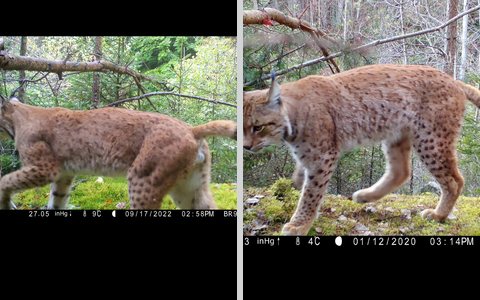
Before and after fine-tuning
One photo pair per dataset, matched by the default matcher and by WildMatch. Switch between them and watch the correspondences and the score change.
Open the demo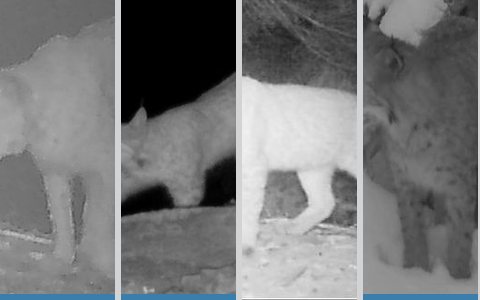
Rank changes
Whole-split counts of rescued, regressed and still-wrong queries on CzechLynx, with random examples under cosine retrieval, default LoMa and WildMatch.
Open the demo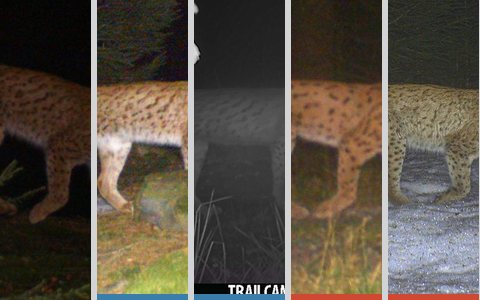
Mined pairs
The training signal: for each anchor, the positives and hard negatives the pretrained matcher mined, with their scores and correspondences.
Open the demo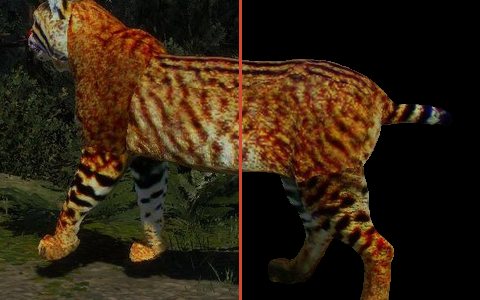
Background masking with SAM 3
Drag a divider between the raw image and the masked model input, compare SAM 3 with the masks a dataset ships, and read the detection confidence.
Open the demo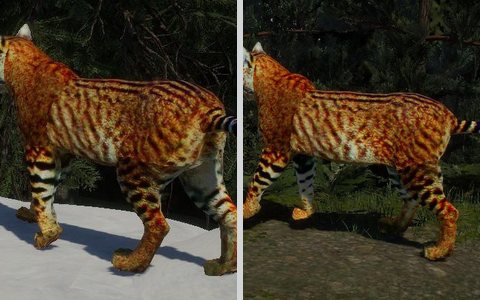
Synthetic keypoint matching
Ten synthetic lynxes, two renders each. Pick a query, let the fine-tuned matcher rank the gallery and inspect every correspondence.
Open the demoHow to read the demos
- Score is the matcher's image score: the summed confidence of the mutual-nearest matches above the threshold, divided by the smaller keypoint count, as in the paper.
- Lines are correspondences between the two photos. Their weight follows confidence, hovering one shows its exact value, and a slider sets how many of the strongest are drawn.
- Masks: matches are computed on background-removed inputs, the inputs the paper uses, and drawn on the original photos.
- Frames: blue marks the true individual, red marks a hard negative or a SAM 3 mask outline; each page explains its own colours.
Photographs from CzechLynx (Picek et al.), WildlifeReID-10k and SalamanderID2025 (AnimalCLEF 2025), the latter shown with the dataset team's permission. Synthetic lynx renders from the CzechLynx synthetic subset, Zenodo record 17592004, CC BY 4.0.