Beyond the paper
Results after the paper
Everything on this page was produced after the paper and is not part of it: RDD-LightGlue retrained with the paper's LoMa recipe (the matching module on seven datasets and the descriptor branch on CzechLynx), the paper's methods rerun on new SAM 3 masks, and a dataset outside the paper, JaguarReID. The paper's own numbers are on the other result pages.
RDD-LightGlue with the shared recipe
The paper fine-tunes LoMa with one recipe: the relaxed pair score, a triplet margin objective,
AdamW and pairs mined with LoMa. Most of the paper's RDD-LightGlue checkpoints were trained with an
earlier recipe. We retrained RDD-LightGlue with the LoMa recipe on the seven datasets where it
differed (Hyena, Leopard, Sea star, Whale shark, Turtle, Salamander and CzechLynx open, which serves
the unseen-individual protocol). These retrained checkpoints are now the wildmatch defaults and are
on the Hugging Face Hub; the paper's checkpoints stay available
(wildmatch weights download --set paper).
Top-1 / balanced top-1 in % at \(k = 250\); the last column is the change in top-1 against the paper's fine-tuned checkpoint (retrained minus paper).
| Dataset | Default | Paper fine-tuned | Retrained | Change |
|---|---|---|---|---|
| Hyena | 90.8 / 85.7 | 88.4 / 82.4 | 87.6 / 82.4 | -0.8 |
| Leopard | 82.3 / 55.0 | 80.3 / 52.1 | 77.3 / 49.3 | -3.0 |
| Sea star | 93.7 / 94.5 | 94.2 / 95.1 | 93.7 / 94.8 | -0.5 |
| Whale shark | 63.6 / 52.0 | 63.0 / 53.1 | 66.4 / 55.8 | +3.3 |
| Turtle | 50.5 / 38.7 | 32.8 / 31.8 | 47.1 / 47.4 | +14.4 |
| Salamander | 42.3 / 43.7 | 41.9 / 43.3 | 43.9 / 45.6 | +2.0 |
| CzechLynx unseen (k = 160) | 25.9 / 26.7 | 30.2 / 29.7 | 31.5 / 29.1 | +1.3 |
- Where the shared recipe helps: Turtle gains 14.4 points of top-1 and Whale shark 3.3, with the gain growing with \(k\); Salamander and the unseen CzechLynx individuals gain 1 to 2 points.
- Where it does not: Leopard loses 3.0 points at \(k = 250\) (up to 6 at \(k = 1000\)); Hyena and Sea star change by less than one point.
- Why: both checkpoints score exactly the same candidate list, so the difference lies in how each scores candidates far down MegaDescriptor-L's ranking, which only enter at larger \(k\). On Leopard the retrained checkpoint lets more of these far candidates outscore the right individual; on Turtle it lets fewer.
- On Hyena, Leopard and Turtle the default RDD-LightGlue has a higher top-1 than both fine-tuned versions at \(k = 250\), so fine-tuning RDD-LightGlue does not raise top-1 on every dataset.
The RDD descriptor branch with the shared recipe
The paper's part-adaptation comparison fine-tunes the RDD descriptor branch alone on CzechLynx (closed split), with the earlier recipe and stopped at epoch 175 by the cluster's time limit. We retrained it with the shared recipe for the full schedule (epoch 299); the detector and LightGlue keep their default weights, as in the paper. It is reported separately from the matching-module checkpoints above.
| Checkpoint | 10 | 50 | 100 | 250 | 500 | 1000 |
|---|---|---|---|---|---|---|
| RDD-LightGlue (default) | 34.0 / 14.2 | 44.3 / 22.6 | 49.4 / 27.3 | 56.0 / 33.4 | 61.1 / 38.3 | 65.6 / 43.5 |
| Descriptor, paper (epoch 175) | 35.1 / 13.5 | 43.2 / 19.4 | 46.5 / 22.4 | 49.8 / 25.7 | 52.3 / 28.6 | 53.0 / 30.6 |
| Descriptor, shared recipe (epoch 299) | 34.7 / 13.5 | 44.2 / 20.3 | 47.7 / 24.2 | 51.9 / 28.0 | 54.6 / 32.0 | 56.5 / 35.3 |
Top-5 / balanced top-1 in % on CzechLynx (closed split); columns are the candidate budget \(k\).
- The retrained descriptor is better than the paper's at every \(k\) from 50 on: at \(k = 250\) top-5 rises from 49.8 to 51.9 and balanced top-1 from 25.7 to 28.0 (top-1 34.4 to 38.0), and the gain grows with \(k\) (top-1 +5.5 points at \(k = 1000\)).
- It still stays below the default RDD-LightGlue from \(k = 50\) on (at \(k = 250\): 5.4 points less balanced top-1), so the paper's conclusion holds: for RDD-LightGlue, adapt the matching module, not the descriptor alone.
- The recipe and the training length both changed, so this comparison does not say which of the two accounts for the gain.
SAM 3 masks
The paper's WildlifeReID-10k inputs are background-removed photos made earlier in the project,
with an unrecorded method. We rebuilt every mask with SAM 3; wildmatch prepare rebuilds them from
the original release, and they are now the registry's default inputs (the paper's tables stay
available as paper_inputs). Rerunning the paper's methods on the new inputs changes top-1 by less
than one point on four of the six datasets:
| Dataset | Configurations | Mean change in top-1 (points) |
|---|---|---|
| Hyena | 7 | +0.8 |
| Leopard | 7 | +0.2 |
| Nyala | 7 | +1.2 |
| Sea star | 7 | +2.4 |
| Whale shark | 7 | +0.4 |
| Turtle | 7 | -0.6 |
Mean over the seven configurations at \(k = 250\) (cosine, WildFusion, the classifier probe and the default and fine-tuned LoMa and RDD-LightGlue).
Sea star: twelve blank query photos
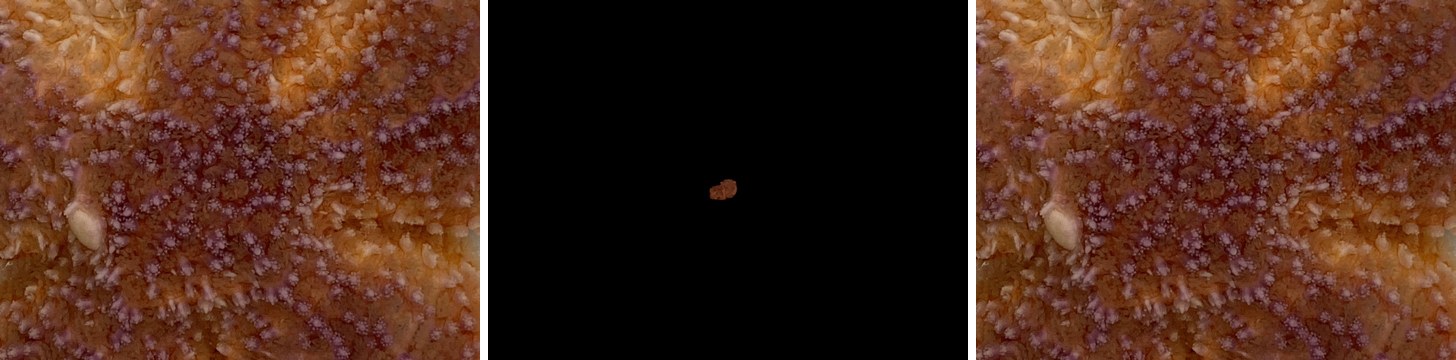
The whole Sea star gain comes from 12 test queries whose old mask kept only a speck of the photo (under 1 % of the pixels), although the photos are valid close-ups of the animal. With SAM 3 these 12 queries keep the whole photo; the paper's runs identified 0 to 2 of them correctly, the reruns 10 to 12. On the other 416 queries the change averages −0.02 points.
| Method | Paper masks | SAM 3 masks |
|---|---|---|
| Cosine (MegaDescriptor-L) | 78.0 | 79.4 |
| Linear probe (frozen, class-weighted) | 59.1 | 61.4 |
| LoMa (default) | 96.3 | 99.3 |
| LoMa (fine-tuned) | 96.7 | 99.5 |
| RDD-LightGlue (default) | 93.7 | 96.0 |
| RDD-LightGlue (fine-tuned) | 94.2 | 96.5 |
| WildFusion | 94.6 | 97.2 |
Top-1 in % on Sea star at \(k = 250\), paper inputs against SAM 3 inputs.
JaguarReID
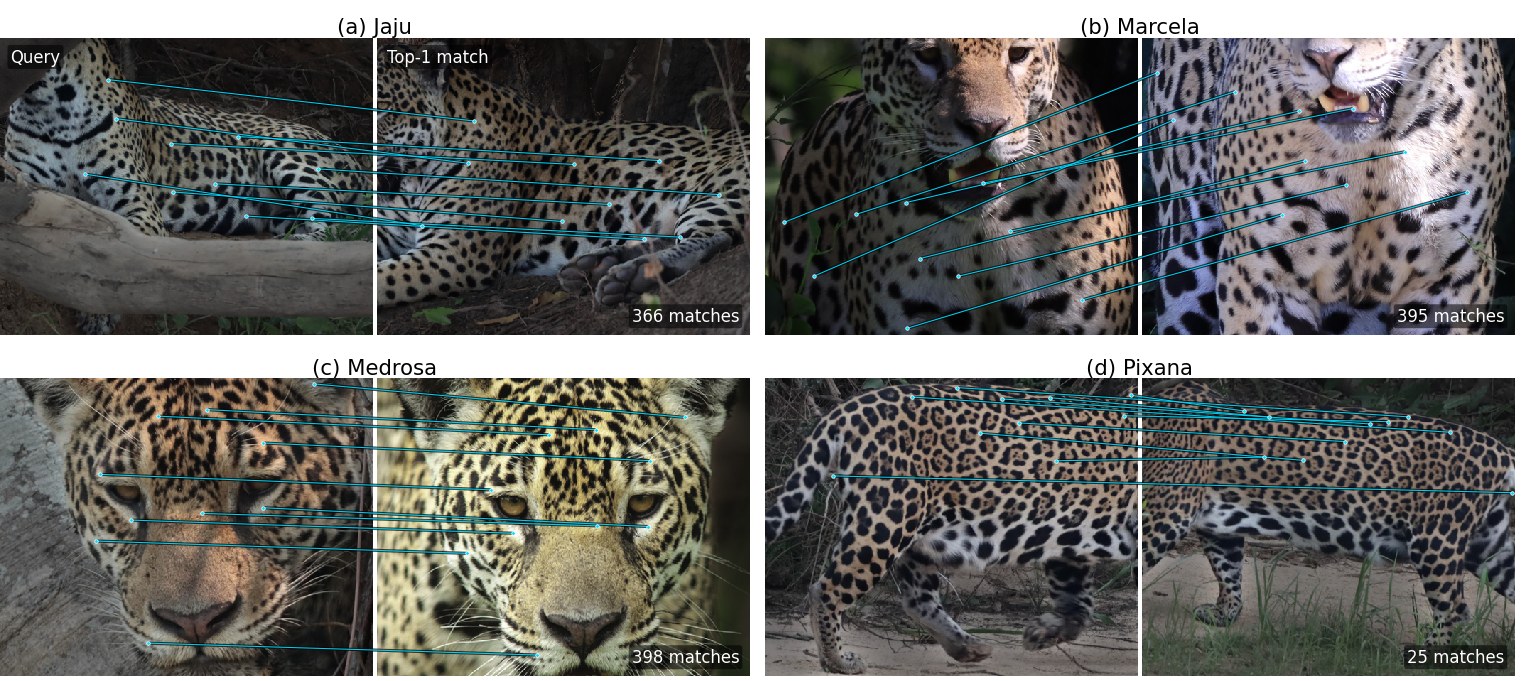
JaguarReID is the labelled part of the Kaggle Jaguar Re-ID competition data: 1,895 photos of 31 jaguars, used for research with the competition authors' permission. The photos come in bursts of near-identical frames, so the split keeps each burst on one side: 1,408 gallery photos and 487 queries, every jaguar on both sides. We mined pairs and fine-tuned both matchers with the paper's pipeline and recipe.
Top-1 in %; columns are the candidate budget \(k\). Cosine and the classifier probe rank the whole gallery and do not depend on \(k\).
| Method | 10 | 50 | 100 | 250 | 500 | 1000 |
|---|---|---|---|---|---|---|
| LoMa (default) | 61.8 | 73.7 | 77.4 | 83.4 | 86.7 | 90.3 |
| LoMa (fine-tuned) | 63.4 | 76.0 | 79.1 | 84.8 | 87.7 | 90.1 |
| RDD-LightGlue (default) | 60.0 | 69.8 | 74.1 | 80.1 | 84.4 | 88.7 |
| RDD-LightGlue (fine-tuned) | 60.0 | 70.8 | 73.9 | 80.1 | 84.2 | 87.9 |
| WildFusion | 60.4 | 71.3 | 75.6 | 81.3 | 84.2 | 88.3 |
| Cosine (no k) | 45.2 | 45.2 | 45.2 | 45.2 | 45.2 | 45.2 |
| Linear probe (no k) | 34.3 | 34.3 | 34.3 | 34.3 | 34.3 | 34.3 |
- Fine-tuning LoMa adds 1.0 to 2.3 points of top-1 up to \(k = 500\) (at \(k = 250\): 83.4 to 84.8).
- Fine-tuned RDD-LightGlue keeps its top-1 but gains 1.5 to 2.8 points of balanced top-1 up to \(k = 500\) (at \(k = 250\): 73.5 to 76.3), so it helps the rarely photographed jaguars.
- The gains are smaller than on the paper's datasets: burst-like near-identical positives make the mined training pairs easy, and the training loss falls to about zero early.
Reproduce
wildmatch sweep rdd_relaxed --submit             # retrained RDD-LightGlue, six datasets, k = 10-1000
wildmatch sweep rdd_relaxed_czechlynx --submit   # unseen CzechLynx individuals, k = 10-160
wildmatch sweep rdd_relaxed_descriptor --submit  # retrained RDD descriptor, CzechLynx closed, k = 10-1000
wildmatch sweep wildlife_sam3 --submit           # SAM 3 inputs, k = 250 (wildlife_sam3_grid: other budgets)
wildmatch sweep jaguar_grid --submit             # JaguarReID, default weights
wildmatch sweep jaguar_finetuned --submit        # JaguarReID, fine-tuned matchers
python paper/page/export_beyond_paper.py rebuilds this page's data; export_seastar_masks.py and
export_jaguar_examples.py (GPU) rebuild the two figures.