Qualitative results
Matches on correct top-1 retrievals
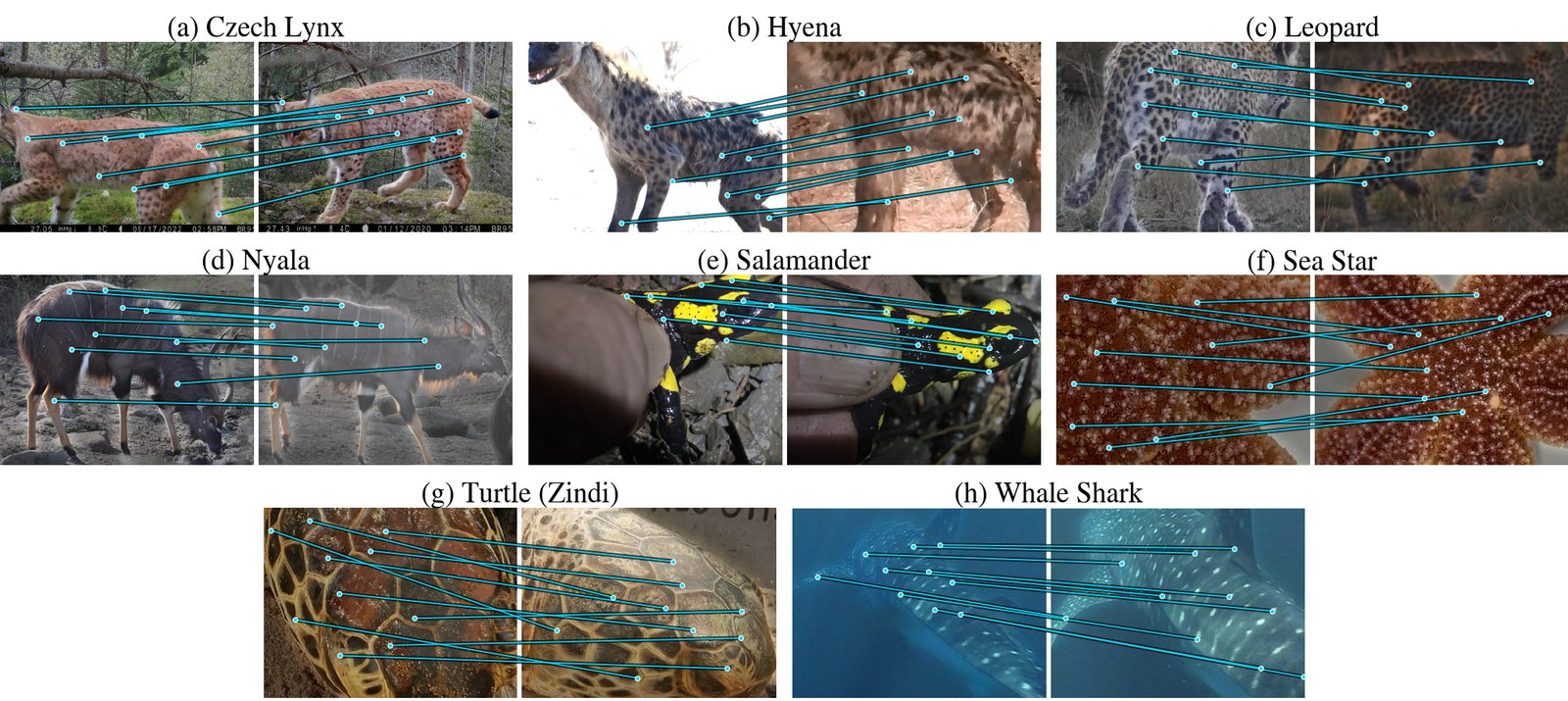
One correct top-1 retrieval per dataset with the fine-tuned LoMa matcher at \(k = 50\). The query is on the left, its top-1 gallery image of the same individual on the right. Of the 350 to 420 matches found for each pair, lines show the 10 most confident, chosen for spatial spread. Matching uses background-removed inputs, and the matches are drawn on the original photos.
Explore the matches
The before and after demo shows these eight pairs interactively: every correspondence with its confidence, the match count, and the same pair under the default matcher for comparison.
How the examples were chosen: candidates are correct top-1 queries from the run's stored score matrix, excluding pairs from the same encounter or capture day where the metadata records them, and excluding near-duplicate photos. Candidates were sorted by MegaDescriptor-L cosine similarity, hardest first, and one pair per dataset was chosen by eye from a contact sheet. Rank 1 is always read from the run's stored scores, never recomputed.
Why this matters
The correspondences link parts of the coat, skin or shell pattern across changes in viewpoint and illumination: the spots of the hyena and the leopard, the stripes of the nyala, the yellow patches of the salamander. Because the ranking is built from these correspondences, every retrieval can be inspected. An expert can check which markings support a proposed match before accepting it, which a similarity score from a global embedding alone does not show. In conservation monitoring a wrong identity propagates into population estimates.
Challenging images
See Known data problems for the raw-photo examples of overexposure, insufficient detail, empty frames, corruption and blur that remain in every method's database and query sets.